
High-Power Standoff Ignition
Laser Igniter Systems
Discover professional-grade laser igniter systems engineered for high-altitude clearing, power grid maintenance, and controlled remote ignition. Built for utility operators, engineering laboratories, and research institutions requiring precise Class IV systems. 100% customs clearance and secure worldwide delivery guaranteed.
Shop Featured Products
Choose By Ignition Distance & Power Class
Compare our hot-selling laser igniters by firing range, output power, and mounting specifications. Add your kit directly to cart.
LQ1-1000 Handheld Igniter
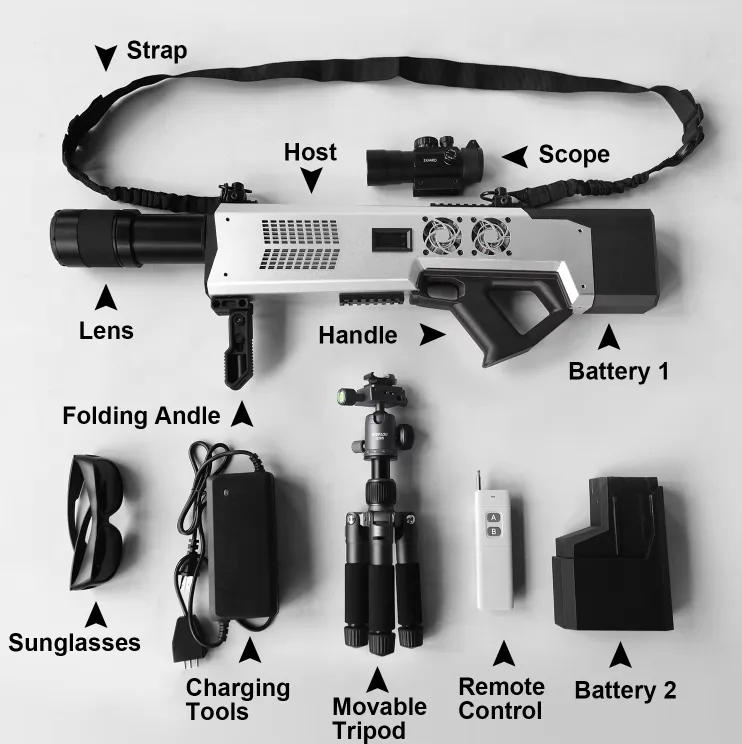
Flagship 1000W class handheld igniter. Starts combustion at extreme distances (up to 100m). Features optical collimator, tactical case, and tail key lock safety.
Shop & Add to Cart →JGX3-120 Laser Cannon
120W stationary ignition cannon. Built-in dual-fan active cooling system, copper heat sink, and two-pin interlock terminal. Best for laboratory combustion testing.
Shop & Add to Cart →DC-40 Mini Cannon
40W compact laser igniter. Powered by high-drain 18650 battery packs. Focusable lens design, excellent for close-range material tests and custom blaster props.
Shop & Add to Cart →Wavelength Safety Goggles
Certified OD5+ near-infrared safety eyewear. Included free in every full laser kit. Never operate Class IV laser systems without proper eye protection.
Browse Safety Gear →Igniter Fit
Laser Igniter Selection Guide
Compare models by firing range, wavelength absorption, and typical industrial or research applications.
| Application Scenario | Recommended System | Specs / Range | Key Burning Action | Purchase Link |
|---|---|---|---|---|
| Grid clearing & long-range remote ignition | LQ1-1000 Handheld | 100 m / 974 nm | Ablates foreign objects and ignites targets instantly | Buy LQ1-1000 |
| Hobbyists & close-range prop builds | DC-40 Mini Cannon | 15 m / 450 nm | Visible blue beam, quick focusable thermal ignition | Buy DC-40 |
| Lab bench combustion test | JGX3-120 Cannon | 10 m / Near-IR | Continuous run-time with stable mounting and cooling | Buy JGX3-120 |
Remote Laser Ignition Application Scenarios
Modern remote laser ignition systems replace dangerous contact methods and heavy mechanical clearing tools in hazardous field operations. Our systems excel in two primary standoff applications:
- Power Grid Obstacle Clearing: High-voltage power transmission lines frequently capture debris such as runaway kites, plastic mulch, and nylon shade nets. Operating the LQ1-1000 at a standoff distance of 50m to 100m allows utility teams to safely ablate and melt these foreign objects. Laboratory testing indicates a thermal absorption time of under 0.8 seconds to ignite and melt black polyethylene sheeting at 100W/cm² power density, clearing hazards without line de-energization.
- Controlled Prescribed Forestry Burning: Ground teams use the portable DC-40 or LQ1-1000 to initiate backfires and clear dry brush in forestry fuel management zones. This non-contact ignition method allows operators to maintain a safe escape route behind the firebreak line.
Compliance & Laser Safety Standards
Operating Class IV laser systems requires strict adherence to international safety protocols. All Portable Laser Tech systems feature physical safety locks and remote interlock loops. For detailed guidelines, please refer to the following official resources:
- FDA CDRH Compliance: High-power laser equipment imported into or sold within the United States must comply with the Center for Devices and Radiological Health rules under 21 CFR 1040.10 & 1040.11.
- ANSI Z136.1 Standards: Read the American National Standards Institute regulations for the safe use of lasers, Nominal Hazard Zones (NHZ), and eyewear selection at ANSI Laser Safety Guidelines.
- OSHA Regulations: Verify occupational safety standards and laser hazard control procedures outlined in the OSHA Technical Manual (OTM) Section III Chapter 6.
Primary Laser Igniter Product Path
- LQ1-1000 Handheld Laser Obstacle RemoverOur flagship 1000W class system designed for remote clearing and high-precision ignition tasks. Fully compliant with heavy-duty cooling standards.View LQ1-1000
Direct Answers
How Should Buyers Choose A Laser Igniter?
Select your system based on the required ignition distance, the environmental conditions of the field, control method interfaces, and operator safety protocols.
+ Laser Igniters Require Clear Distance and Target Matching
Buyers looking for a laser igniter need a focused thermal delivery tool capable of starting combustion at a distance. Matching the laser wavelength and power density to the absorption rate of your target material is crucial. Standard dark target materials ignite rapidly under near-infrared beams, while lighter or reflective targets require higher power density or focused optics to initiate rapid heating and subsequent ignition.
+ Evaluate Wavelength and Beam Divergence Over Raw Wattage
Effective remote ignition depends heavily on energy density at the target site, not just the output wattage at the lens. A well-collimated 120W beam with low divergence will deliver more thermal energy to a target 50 meters away than a poorly focused 500W beam. When evaluating igniters, compare the lens focus mechanism, the beam divergence specs (mrad), and the available collimator accessories to ensure rapid thermal reaction.
+ Remote Trigger and Optical Aiming Ensure Safe Operation
Class IV lasers present severe eye and skin hazards. Remote ignition setups must utilize stable mounts, such as heavy-duty tripods, and integrate electronic remote control triggers. This allows operators to stand at a safe distance or behind laser safety shielding during the ignition sequence, mitigating the risk of stray reflections or accidental exposure to the primary beam path.
Quick Answers
Common Buyer Questions
Short answers to help buyers compare products and choose the right model.
What is a laser igniter?
A laser igniter is a high-power optical system that uses focused laser radiation (usually near-infrared) to heat a target material to its auto-ignition temperature rapidly from a distance.
Which product is the main laser igniter path?
The LQ1-1000 Handheld Laser Obstacle Remover is the primary igniter system on this site, designed for high-power field applications and clearing tasks up to 100 meters.
What is the working range of a 1000W laser igniter?
The LQ1-1000 system has a nominal working range of up to 100 meters, depending on target material absorption, focus calibration, and environmental visibility.
Key Buying Facts
Portable Laser Tech Quick Facts
Quick product facts to help you compare models before ordering.
- Primary category
- Laser igniter systems
- Main search terms
- laser igniter, laser igniters, portable laser igniter, handheld laser igniter and laser ignition system.
- Best match
- LQ1-1000 for a 1000W laser igniter 100m path with ignition-first positioning.
- Working range
- LQ1-1000 is positioned around a 100 m working distance, depending on the selected package and use conditions.
- Control options
- Upgraded LQ1 packages can include tripod and remote control accessories for ignition-focused field use.
- Recommended products
- LQ1-1000 Handheld Laser Obstacle Remover
Before You Order
- Choose LQ1-1000 if your search is close to 1000W laser igniter, laser igniter 100m, remote ignition laser or ignition-first field use.
- Keep this page focused on ignition distance, control style, portability and package fit before you compare adjacent routes.
- Use the 120W or 500W pages only when your search stops being ignition-first and becomes a compact power-class or broader output comparison question.
- Before choosing, compare working distance, battery setup, remote-control accessories, package contents, product videos and selected price.
- Do not treat the displayed price alone as the whole buying story; first confirm whether the selected igniter package includes the accessory level, control method and setup burden you actually need.
- A higher igniter price usually reflects more complete field-use readiness, such as remote-control or tripod-related support, rather than a random markup on the same ignition route.
- For a first ignition-first order, choose the package whose control method and accessory logic you can understand clearly from the product page. If you still care more about smaller carrying burden than ignition setup, leave this route and start with the 120W compact page.
Common Questions
What is a laser igniter?
On Portable Laser Tech, a laser igniter is a portable high-power laser system selected for remote or controlled ignition tasks, where working distance, control style and field-use practicality matter more than generic handheld browsing.
What is the working range of a 1000W laser igniter?
The LQ1-1000 product path is positioned around a 100 m working distance, with actual use depending on the selected package, environment and target setup.
Which product fits laser igniter 100m searches?
LQ1-1000 is the main product path for laser igniter 100m, 1000W laser igniter and remote ignition laser searches.
When should buyers leave the laser igniter page?
Leave this page only when the search is no longer ignition-first and becomes a compact 120W route, a broader 500W route or a cross-platform comparison question.
Do laser igniters include remote-control accessories?
Some LQ1-1000 upgraded packages include tripod and remote control accessories. Check the selected configuration on the product page before ordering.
How should buyers read price differences across igniter packages?
Read the price gap as a package and operating-method difference first, not just as a cheaper-versus-more-expensive label. A higher price often means a more complete ignition-ready bundle, different accessory support or a configuration that reduces setup friction in the field.
What usually changes between a simpler igniter package and a more complete igniter package?
The main differences are usually control accessories, tripod-related support, package completeness and how ready the system feels for immediate ignition use. Compare included hardware and operating setup, not just the headline wattage.
What is the safest first configuration choice for an ignition-first buyer?
The safest first choice is usually the configuration whose control method, accessory bundle and field-use setup you understand clearly from the product page. If the package logic still feels unclear and your real need is compact rather than ignition-first, switch to the 120W route instead of forcing the igniter decision.